

Working Principle and Characteristics of Pneumatic Conveying for Carbonaceous Granular Materials
HeadPowder, a leading provider in the field of material handling solutions, specializes in the technology of pneumatic conveying for carbonaceous granular materials. This article aims to explain the fundamental working principle and key characteristics of this process, offering insights into how it operates and its advantages in material transport.

Understanding Pneumatic Conveying Systems
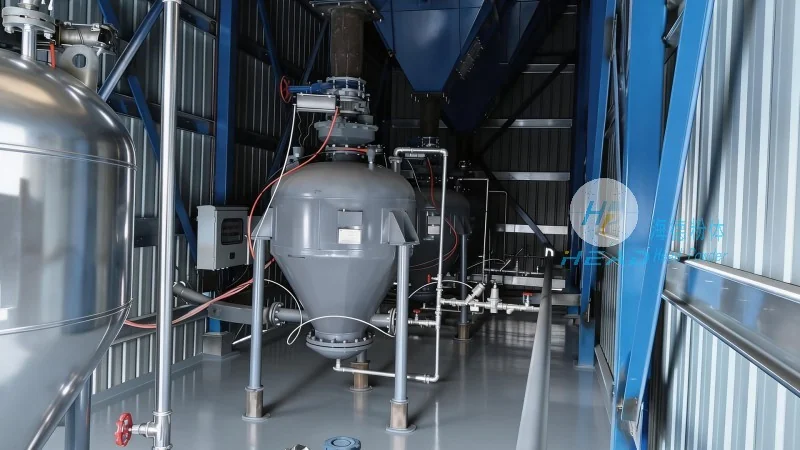
Pneumatic conveying, also known as pneumatic transport, is a method used to move bulk materials through a pipeline using a gas stream, typically air or other gases. The system consists of several components including a material feed hopper, a conveyor line, a gas source (like a blower or compressor), and a discharge point. The core of the process involves creating a pressure differential or using vacuum to draw or push the material particles along the pipeline.
The Working Principle of Carbonaceous Granular Materials Conveying
For carbonaceous granular materials, such as carbon black, graphite, or other similar powders, the pneumatic conveying process operates based on the principles of fluidization and particle suspension. The material is first fed into the system from a hopper. A gas stream, often under pressure, is introduced into the pipeline, creating a flow that lifts and transports the particles. The key steps include material feeding, air-gas mixing, particle suspension, and final discharge. The system can be designed as either a pressure system (where air is compressed and pushed through the line) or a vacuum system (where a vacuum is created to draw material into the line). The choice of system depends on factors like material properties, distance, and system layout.

Key Characteristics of Pneumatic Conveying for Carbonaceous Materials
There are several notable characteristics that define the performance of pneumatic conveying systems for carbonaceous granular materials. Firstly, the system offers a closed-loop transport, which helps in maintaining material integrity and preventing contamination or dust emissions. This is particularly important for carbonaceous materials that may be sensitive to environmental factors or require a controlled environment. Secondly, the process allows for high-velocity transport over relatively long distances, making it suitable for industrial applications where materials need to be moved from one location to another efficiently. Thirdly, the system can handle a wide range of particle sizes and densities, adapting to different types of carbonaceous materials. Additionally, the equipment is generally compact and can be integrated into existing industrial setups, reducing space requirements and installation complexity. Another characteristic is the ability to control the flow rate and pressure, which is crucial for maintaining consistent material transport and preventing system overload or blockages.
Applications and Benefits in Industrial Settings
HeadPowder's expertise in pneumatic conveying for carbonaceous granular materials is applied across various industrial sectors. These systems are commonly used in the production of carbon products, where materials need to be transported between processing stages without degradation. The benefits of using such systems include improved safety by containing dust and reducing exposure risks, enhanced efficiency through automated material handling, and cost savings by minimizing material loss and downtime. The technology also supports sustainable practices by reducing the need for manual handling and minimizing environmental impact.
Conclusion
HeadPowder Engineering Co., Ltd., based in Shandong, China, provides comprehensive solutions for pneumatic conveying of carbonaceous granular materials. By understanding the working principles and characteristics of these systems, industries can optimize their material handling processes, ensuring efficiency, safety, and sustainability. The company's commitment to quality and innovation ensures that clients receive tailored solutions that meet their specific operational needs.