

Analysis of Sulfate Nickel Crystallization Pneumatic Conveying Technology: Comparison of Positive an
For the efficient handling and transportation of sulfate nickel crystallization products, pneumatic conveying technology has become a key solution in industrial processes. This article provides a detailed analysis of the two primary modes of pneumatic conveying—positive and negative pressure systems—focusing on their applications, advantages, and limitations in the context of sulfate nickel crystallization. The comparison aims to help industry professionals select the most suitable conveying method based on specific operational requirements, with insights from Shandong HeadPowder Engineering Co., Ltd., a leading provider of engineering solutions for material handling in China.

Introduction to Sulfate Nickel Crystallization and Pneumatic Conveying
Sulfate nickel is a critical raw material widely used in battery manufacturing, electroplating, and other industrial applications. The crystallization process produces solid particles that need to be transported from the crystallizer to storage or processing units. Pneumatic conveying offers a dust-free, continuous, and flexible method for handling these particles, eliminating the need for traditional bulk handling equipment like conveyor belts or elevators. However, the choice between positive and negative pressure systems depends on factors such as particle size, moisture content, and the distance of transportation.
Positive Pressure Pneumatic Conveying System
Positive pressure systems operate by blowing air into the conveying line, creating a pressure higher than the ambient air pressure. This method is particularly effective for transporting fine particles with low moisture content, as the high-pressure air can maintain particle suspension and prevent clogging. The system typically consists of a blower, a feed hopper, a conveying pipe, and a discharge device. The blower supplies compressed air, which is introduced at the inlet of the conveying line, and the air flow carries the particles forward. A key advantage of positive pressure systems is their ability to handle long distances and multiple transfer points without significant pressure loss. They are also suitable for transporting particles with low abrasiveness, as the high-pressure air reduces particle-to-particle and particle-to-pipe friction. However, these systems require robust equipment to withstand high pressure and may need additional filtration to prevent air contamination.

Negative Pressure Pneumatic Conveying System
Negative pressure systems, also known as suction systems, operate by creating a vacuum in the conveying line, drawing air and particles into the system. The air is then filtered and released into the environment. This mode is ideal for applications where the material needs to be collected from a source with a high dust generation rate, such as a crystallizer or a storage silo. Negative pressure systems are particularly effective for handling particles with higher moisture content or larger particle sizes, as the vacuum helps maintain particle flow and prevents blockages. The system includes a vacuum pump, a collection hopper, a conveying pipe, and a filter unit. The vacuum pump creates a low-pressure environment, and the particles are drawn into the pipe along with the air. A major advantage of negative pressure systems is their ability to handle particles that are difficult to convey under positive pressure, such as sticky or cohesive materials. However, they are generally less suitable for long-distance transport due to the limitations of vacuum pressure and may require more maintenance to prevent dust accumulation in the system.
Comparison of Positive and Negative Pressure Systems in Sulfate Nickel Crystallization
When selecting between positive and negative pressure pneumatic conveying systems for sulfate nickel crystallization, several factors must be considered. The choice is often determined by the physical properties of the crystallization product, such as particle size distribution, moisture content, and flowability. Positive pressure systems are generally preferred for fine, dry particles with low moisture content, as they offer higher conveying capacity and longer transport distances. For example, in battery-grade sulfate nickel production, where the particles are typically fine and require high purity, positive pressure systems can ensure efficient and clean transport without compromising product quality. In contrast, negative pressure systems are more suitable for handling larger or more moist particles, such as those from a crystallizer with high moisture content. These systems can effectively collect and transport particles that might clog positive pressure lines due to their sticky nature.

Key Considerations for System Selection
Beyond the physical properties of the material, other factors influence the choice of pneumatic conveying mode. The distance between the crystallizer and the storage or processing unit is a critical factor. Positive pressure systems are better suited for long-distance transport, as they can maintain sufficient pressure to move particles over extended lengths. Negative pressure systems, on the other hand, are limited by the vacuum pressure and are more appropriate for shorter distances or when the material is collected from a specific point. The cost of equipment and maintenance is another consideration. Positive pressure systems often require more powerful blowers and may need additional filtration, increasing initial investment and operational costs. Negative pressure systems typically use vacuum pumps, which can be more expensive to maintain but may be more cost-effective for certain applications due to lower energy consumption in some scenarios. Environmental regulations also play a role, as negative pressure systems may require more stringent filtration to comply with air quality standards, especially when handling particles with high dust content.
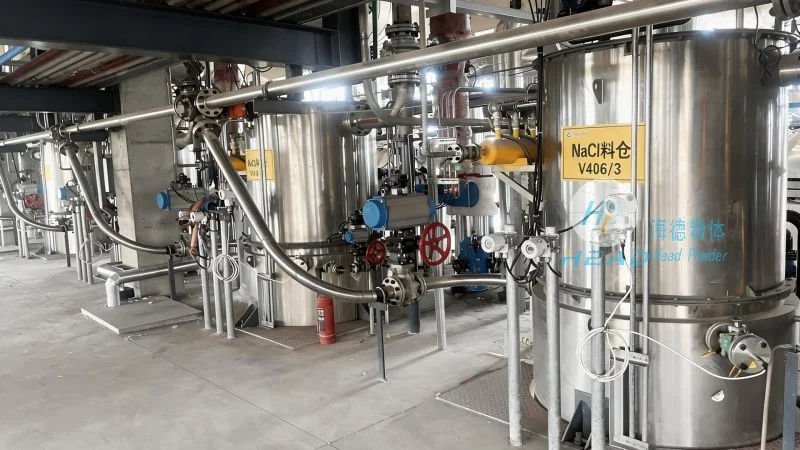
Application Examples in Sulfate Nickel Industry
Real-world applications of both positive and negative pressure pneumatic conveying systems in the sulfate nickel industry illustrate their effectiveness. For instance, a large-scale battery manufacturer in China uses a positive pressure system to transport fine sulfate nickel crystals from the crystallizer to a storage silo, covering a distance of over 100 meters. The system operates continuously, ensuring a steady supply of material to the next processing stage without interruptions. The positive pressure blower maintains a consistent pressure, preventing particle clogging and maintaining product purity. Conversely, a smaller electroplating facility uses a negative pressure system to collect crystallization residues from a storage bin. The vacuum pump draws the moist, sticky particles into the conveying line, which are then filtered and deposited in a collection container. This method effectively handles the high moisture content and cohesive nature of the residues, preventing dust contamination in the facility.
Conclusion
In conclusion, both positive and negative pressure pneumatic conveying systems offer viable solutions for the transportation of sulfate nickel crystallization products, each with distinct advantages and limitations. Positive pressure systems excel in handling fine, dry particles over long distances, while negative pressure systems are better suited for larger or more moist particles and applications requiring dust collection. The selection of the appropriate system depends on a thorough analysis of the material properties, operational requirements, and cost considerations. By understanding the differences between these two modes, industry professionals can optimize their conveying processes, improve efficiency, and ensure product quality in sulfate nickel production. As the demand for sulfate nickel continues to grow, the adoption of efficient and reliable pneumatic conveying technologies will remain crucial for meeting industrial needs.