

Operation Process and Working Principle of Quartz Sand Particle Material Pneumatic Conveying System
Quartz sand, a fundamental raw material in various industries including glass manufacturing, foundry, and construction, demands efficient and safe transportation methods to maintain its quality and prevent contamination. Pneumatic conveying systems have become the preferred choice for handling quartz sand particles due to their ability to transport materials in a closed system, minimizing dust exposure and ensuring consistent material flow. This article delves into the operation process and working principle of quartz sand particle material pneumatic conveying systems, emphasizing the technical aspects and practical applications. The discussion is anchored by the expertise of Shandong HeadPowder Engineering Co., Ltd. (headpowder), a leading provider of pneumatic conveying solutions based in Shandong, China.


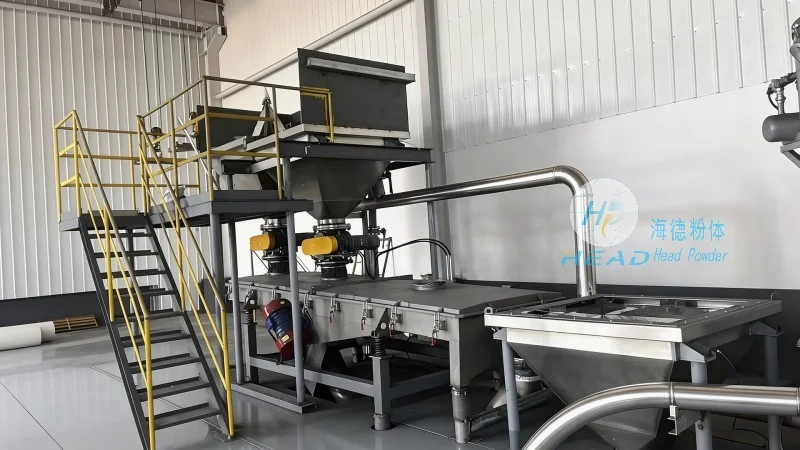
Working Principle of Pneumatic Conveying Systems for Quartz Sand
The core of pneumatic conveying systems lies in the interaction between air and solid particles. For quartz sand, which typically ranges from fine powders to coarse granules, the system operates by creating a high-velocity air stream that entrains the particles. Two main types of systems are used: pressure and vacuum. Pressure systems utilize compressed air to push the material through the pipeline, while vacuum systems employ a negative pressure to pull the material. In quartz sand applications, pressure systems are more common because they can handle higher material loads and longer distances. The system consists of several critical components: a material feeder (e.g., rotary valve or screw feeder) that introduces the sand into the system at a controlled rate; a conveying line (usually made of stainless steel or plastic) that transports the air-sand mixture; a separation unit (such as a cyclone or bag filter) that separates the sand from the air; and a dust collector that removes any residual dust. The material feeder ensures a consistent feed rate, preventing overloading or underloading of the system. The compressed air, often supplied by an air compressor, is introduced into the conveying line at a pressure sufficient to create the necessary velocity to entrain the sand particles. The air velocity must be high enough to keep the particles suspended but not so high as to cause excessive wear on the pipeline or components. The separation unit uses centrifugal force to separate the sand from the air. The sand is collected in a hopper or storage bin, while the air is filtered and discharged. This process ensures that the quartz sand is transported efficiently and with minimal loss or degradation.
Operation Process of Quartz Sand Pneumatic Conveying Systems
The operation of a quartz sand pneumatic conveying system follows a structured sequence to ensure reliable and continuous material transport. The process begins with the preparation phase, where the quartz sand is stored in a hopper or silo and prepared for feeding. The system is then started by activating the air compressor and the material feeder. The air compressor builds up pressure, and the feeder introduces the sand into the conveying line at a predetermined rate. The air flow is adjusted to maintain the desired velocity, which is typically between 20 to 30 meters per second for pressure systems. As the sand particles are entrained by the air, they travel through the pipeline to the receiving hopper. The system is monitored continuously for pressure, flow rate, and material level. If the pressure drops or the flow rate changes, the system may indicate a blockage or other issue. In such cases, the system is shut down and the blockage is cleared. The operation continues until the material is fully transferred or the feeding rate is adjusted. The system is then shut down in a controlled manner, ensuring that all components are properly de-energized and the pipeline is cleared of any residual material. Regular maintenance, including cleaning the separation unit and checking for wear on the feeder and pipeline, is essential to maintain system efficiency and longevity. Proper operation and maintenance help minimize downtime and ensure consistent performance.