

Introduction to the Structure and Working Principle of Borax Granule Pneumatic Conveying Line
HeadPowder, a leading engineering firm based in Shandong, China, specializes in the design and manufacturing of advanced pneumatic conveying systems tailored for various industrial applications. This article provides a detailed overview of the borax granule pneumatic conveying line, focusing on its structural design and operational principles to help potential clients understand its functionality and benefits.

Borax, a key chemical compound widely used in industries such as glass manufacturing, detergents, and pharmaceuticals, often requires efficient and reliable transportation methods to move granular materials from one location to another. The borax granule pneumatic conveying line offered by HeadPowder addresses these needs by leveraging pneumatic technology to transport borax granules with precision and minimal loss.
The system's structural design is engineered to ensure optimal performance and durability. It typically consists of several key components, including a hopper for material storage, a rotary valve for controlled discharge, a conveying pipeline, a dust collector, and a receiver for the delivered material. Each component is carefully selected and integrated to create a seamless flow of borax granules from the source to the destination.
At the heart of the system is the conveying pipeline, which can be either positive or negative pressure depending on the specific requirements of the application. Positive pressure systems use a blower to force air and material through the pipeline, while negative pressure systems use a vacuum to draw material into the line. For borax granules, a positive pressure system is often preferred due to its ability to handle abrasive materials and maintain consistent flow rates.

The rotary valve plays a crucial role in regulating the flow of borax granules from the hopper into the conveying pipeline. It ensures that the material is discharged in a controlled manner, preventing blockages and maintaining a steady supply to the pipeline. This component is designed with wear-resistant materials to withstand the abrasive nature of borax granules, ensuring long-term reliability.
The conveying pipeline itself is constructed from high-quality materials, such as stainless steel or corrosion-resistant alloys, to handle the chemical properties of borax and prevent contamination or degradation of the material. The pipeline is also equipped with bends and fittings that are carefully designed to minimize pressure losses and maintain the integrity of the material flow.
A dust collector is integrated into the system to capture any airborne particles during the conveying process, ensuring compliance with environmental regulations and maintaining a clean working environment. The collected dust is typically stored in a separate container for disposal or reuse, depending on the specific requirements of the facility.
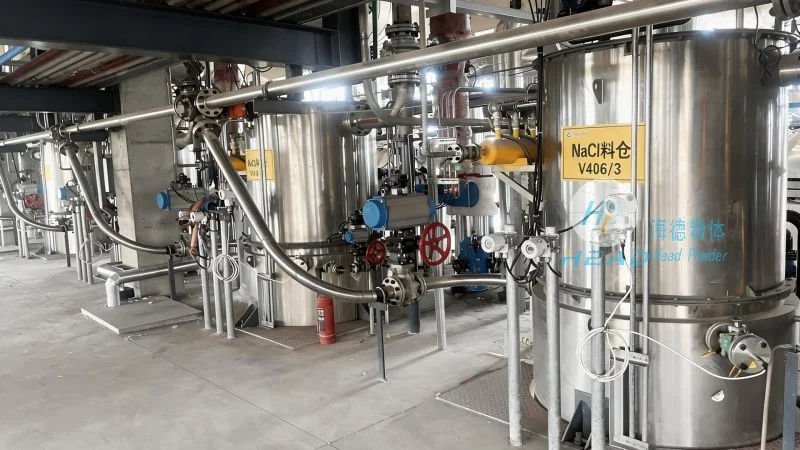
The receiver at the end of the pipeline is designed to safely store the delivered borax granules, preventing spillage and ensuring easy access for subsequent processing or packaging. It is constructed with a sloped bottom to facilitate material discharge and is equipped with a level indicator to monitor the material level inside.
The operational principle of the borax granule pneumatic conveying line is based on the movement of material through the pipeline using air as the conveying medium. When the system is activated, the rotary valve opens, allowing borax granules to enter the pipeline. The blower then introduces high-pressure air into the pipeline, which carries the granules along the path to the receiver. The air and material mixture is then separated at the receiver, with the air being recirculated back to the blower and the material being collected.

This pneumatic conveying method offers several advantages over traditional mechanical conveying systems. It eliminates the need for moving parts in the conveying line, reducing maintenance requirements and increasing system reliability. Additionally, it provides a more hygienic and dust-free environment, which is particularly important for applications involving food-grade or pharmaceutical-grade borax. The system also allows for flexible routing of the pipeline, enabling the material to be transported to multiple destinations from a single source.
HeadPowder's expertise in engineering and manufacturing ensures that the borax granule pneumatic conveying line is customized to meet the specific needs of each client. The company's team of experienced engineers works closely with clients to understand their operational requirements, material characteristics, and environmental constraints, ensuring that the final system is both efficient and cost-effective.
By leveraging advanced technology and high-quality materials, HeadPowder's borax granule pneumatic conveying line provides a reliable and efficient solution for transporting borax granules in various industrial settings. The system's robust design and operational flexibility make it an ideal choice for companies seeking to improve their material handling processes and enhance overall productivity.